Wednesday, 11 October 2017

Literary Lectures - from out of the blue


People sometimes ask where the inspiration for the Hall's events comes from. The answer - more often than not - is out of the blue. The Literary Lectures in the Library for example, they idea for those came from a book I was reading at the time. 

I had read Sally Beauman's book Rebecca's Tale (sadly before I actually read Rebecca, but  never mind...) and enjoyed it so much I started to work my way through her other books. The Landscape of Love was the next book, and even before Chapter One began I was hooked - and not necessarily for the reasons you would expect...

Her description of "Wykenfield" and Abbey were truly uncanny:


"The Convent was founded in 1257 by Isabella de Morlaix, heiress, cousin and friend to Winifride of Ely... The Abbey, under the protection of the monastery at Deepden, flourished until the 15th century, when its influence began to decline. By the time of the Act of Suppression less than a dozen nuns remained. Their lands were then confiscated by the Crown, passing to Sir Gervaise Mortland, a henchman of Henry VIII, in recompense for his role in the vicious suppression of the Pilgrimage of Grace."

Do you see what I mean? It gets better...

"The remaining buildings were occupied by tenant farmers, finally being abandoned in the mid 19th century. In 1919 they were saved from dereliction, and restored by Henry Mortland, formerly of Elde Hall."

And yet there's still more...

"(Fair state of preservation to some parts of the medieval convent structures... The Cloisters, refectory and part of the Lady Capel (13th century) still remain. The moat that surrounded the nunnery enclosure has been drained. The Squint (c. 1450) in the south corridor is quaint, and unique in the county; the reasons for its irreligious placing are unknown.) Present owner: Mr H G Mortland. Private house. Not open to visitors"

And so I was hooked - by what, on first reading, I could see so clearly as a description of Markenfield! What Sally Beauman's inspiration was I don't suppose I will ever know. The big coincidence is that she used to be one of Mr Curteis's neighbours - long before he had ever even heard of the Hall.

The book it split into two parts - then and now - and dare I say it, Then is an awful lot better than Now...

So thank you Sally - for inspiration you will never know.

Sally Beauman: 25 July 1944 - 7 July 2016


Wednesday, 12 April 2017

The Kindness of Strangers

It's not every day that you receive an email like this. Sometimes, out of the blue, someone says something lovely and it really, really makes your day.


My name is Matthew and I’m part of the Marketing Team at Sykes Cottages.

In April, we’ll be launching a month-long campaign celebrating all that is great and good in Yorkshire from our newly re-launched blog, rolling out across our different social media channels, which have over 100,000 followers.

I’m delighted to be able to tell you that Sykes has shortlisted Markenfield Hall as one of Yorkshire’s top 6 hidden gems and will feature in an upcoming campaign article.

I hope you’re pleased about the good news and I look forward to hearing from you soon.


And it was really true! Here we are:

 http://www.sykescottages.co.uk/blog/6-hidden-gems-to-discover-in-yorkshire/

The wording is just lovely - 

"Like in all the best fairy tales, however, the magical entrance to another world isn’t around for long and Markenfield Hall’s is no different; the gates of this unique place are only opened to the public for 30 precious days annually, so make sure you’re amongst the few each year to catch a glimpse of it!"

Thank you Sykes Cottages - you made this Administrator very happy!


Tuesday, 11 April 2017

The tattooed Pilgrim?


It's amazing how sometimes little snippets of information fall into your lap - watching the news last week there was an article about the National Maritime Museum in Cornwall, and a new exhibition on tattoos that they were putting on. 

The article itself was fascinating - and further information on the exhibition can be found here: https://nmmc.co.uk/whats-on/event/tattoo-british-tattoo-art-revealed/ What pricked my ears up was the mention of Mediaeval Pilgrimage tattoos.

It has long been known that Sir Thomas Markenfield (Thomas V) made a Pilgrimage to the Holy Land  in the 1560s, including a visit to the Holy Sepulchre in Jerusalem. We know this as a long list of places that he visited still exists.

At the end of his Pilgrimage Sir Thomas was admitted to the Order of the Holy Sepulchre on 14 June 1566. His citation sets out his credentials:


Lately to the most sacred Holy Land there came on pilgrimage with sincere devotion the Noble and Gentle Thomas Markynfeld of the English Nation and born of noble blood 
Lord of M[arkenfield]

The warrant was sealed with with the seal of the Holy Sepulchre in Jerusalem. To become a member of the Order was considered by Roman Catholics to be an honor worth more than any knighthood conferred by their own Sovereign.

"Accounts of crusaders visiting the Holy Land reveal that tattoos could also serve as permanent proof of pilgrimage trips. One person who has done a great deal of work on pilgrim tattoos is Dr. Anna Felicity Friedman at the Center for Tattoo History and Culture. As she notes, it is likely that  "tattoo practitioners and tattoo recipients looked at and drew from common Christian symbols and iconography around them for inspiration for their tattooed marks of faith." " Forbes.com

Was Sir Thomas Markenfield a tattooed pilgrim? We will probably never know, but the the tattoo shop he may have used still exists to this day: 
 http://www.atlasobscura.com/articles/inside-the-worlds-only-surviving-tattoo-shop-for-medieval-pilgrims


With thanks to Janet Senior's book The Markenfields of Markenfield Hall for the information on Thomas V.

Tuesday, 7 March 2017

Timber!

At the beginning of last year it was decided that the large Sycamore trees that lined the side of the moat were beginning to look rather worse for wear. A closer inspection revealed that they were suffering from various stages of Honey Fungus. The trees at the north end were in a worse state than the trees to the north as can be seen in this quite fascinating picture:


The trees to the north have spent the last couple of winters with their roots in substantial amounts of water after some of the wettest winters in memory. This had weakened them considerably and made them more susceptible to the disease.

After a lot of planning, the day dawned and the trees were brought down...


Last one standing... this one wanted to stay!


The last one was a bit of a struggle! It was the healthiest, but was by no means a healthy tree and would have started to die off like the others if left.

Once they were down we were able to get a better look at them - you can see the dark inner colour, which is where the fungus is attacking the inside of the tree. A quick count of the rings put the trees at around 200 years old, which puts them feasibly within the period of the Victorian restoration of the Hall carried out by 3rd Lord Grantley when he worked with local architect JR Walbran. 


During this time a few internal changes were made, but more striking was the exterior works - which we now know to include the park land. The 3rd Lord Grantley extended the Tudor long low farm buildings (extreme east and west buildings and still in use today) were extended to create two small courtyards either side of the central aisle that visitors see today.


The Friends of Markenfield have been busy fundraising and the new trees will be planted alongside the moat this spring.

Friday, 10 February 2017

Those who measure wealth in money alone...


It was a seemingly innocuous envelope that landed last December on the doormat. What it contained was not so.

It contained maps and plans outlining a proposal for the "Markenfield New Village Settlement" a development of hundreds of new houses covering the farmland from The Old Mediaeval Road down to the A61. 

Accompanying the alarming maps was a letter offering to make the owners "millionaires".

Needless to say, a letter was sent back explaining that the land they were proposing to build upon was worth more to the owners as it was, on an emotional level, than having millions of pounds in the bank and having to drive through something akin to Milton Keynes each and every time they wanted to leave home.

And so life went back to normal - peaceful, quiet and happily un-rich.

Until the Developer turned up at the door one day armed with a clipboard and pamphlets...

...needless to say he was not welcomed with open arms and was in fact threatened with the police should he return!

Markenfield is special - and it will stay that way.

Thursday, 24 November 2016

Seek and ye shall find...


Research can be a thankless task - especially online. You can spend hours looking through lists of searches containing the word Markenfield (now bear in mind the the Archive & Research Group have identified over 16 possible spellings of Markenfield over the years) and some days the most exciting thing that pops up is a pair of Markenfield Lounge Pants - I kid you not!

But not last week... last week contained one of those rare days when you click on that link and you're transported back precisely 116 year in time to a Great Hall hung as a portrait gallery and faces from the past stare out of the screen at you.

Fast forward to today and a visit from three Volunteers from the Pennine Heritage Digital Archive, who have been lovingly taking care of a collection of photographs taken in 1900 by a Mr George Hepworth. 

Mr Hepworth seemingly worked his way around Yorkshire, photographing historic houses - and how glad are we that he did?!

He donated the glass negatives to the Hebden Bridge Local History Society in 1916 and they were digitised and put online by the lovely people we met today.

We now have 11 (yes 11!) images from 1900 that show the Hall pre-restoration, but as a quite-obviously much-loved and very much cared for family home - home of the Foster family, tenant farmers of the day... and still tenant farmers to this day, living just across the Courtyard in the Farmhouse Wing.

Wednesday, 19 October 2016

Shhhh... it's Quiet Week!


One of the most-commented upon things in the Hall's Visitor Book is the atmosphere at Markenfield - benign, tranquil - spiritual even.

One of the hardest things to do is to maintain that atmosphere for all to enjoy.

The Hall isn't just a visitor attraction - it is first and foremost a family home, and much-loved family home at that. It isn't Chatsworth, or Harewood, where the family can take to a a private wing of the house for some peace and quiet - the family live in the rooms that the public see, and this quite often turns them into a visitor attraction too!

Don't get me wrong... the family very much enjoy welcoming visitors into their home. But as you may have read in the latest newsletter, the number of guided tours has sky-rocketed over the past 12 years and there hasn't been a week since the beginning of April when we haven't had a tour or a wedding.

Weddings involve an awful lot of preparation and furniture moving - setting up on the Friday and putting back the following Monday. We don't have a Function Room - we use the Drawing Room, or the Great Hall - imagine someone getting married in your Living Room...

And so we have introduced the idea of Quiet Weeks... one week a month where we have no groups, no weddings and no upheaval. The furniture stays where it should be, the tea urn is switched off and the house get to recharge its atmosphere ready for its visitors the following week.

Shhhhh.... it's quiet week....

Friday, 16 October 2015

The day the Beetles sang...

If there's one thing that we get through a lot of at the Hall at this time of year... it's logs. With three open fires, and a wood-burning stove of epic proportions, the log shed is nothing if not well stocked.


All the wood burned at the Hall is gathered from the Estate's woodland - Spring Wood. It is brought in one autumn, left to season for a year and then chopped and stored in the Log Shed before being brought into the house in small loads as needed throughout the week.

And that was where the problems started...


We were turning the lights off after a guided tour when we noticed a couple of small beetles on one of the tables in the Drawing Room. They were leg-in-the-air so we swept them to one side thinking we'd look at them in better light the next day. The next day? They'd moved! This time they were under the lamp. So we went on a bug hunt and low and behold - there were more - under lamps and on window cills. 

Fearing the worst we Googled Death Watch Beetle - far to big. Woodworm - still far too big. So, feeling slightly more positive that the house wasn't been chewed from the inside out, we called the Architect... Take a photo he said, it's simple he said. Have you ever tried to take a photo of something the size of a grain of rice?

This is what we came up with! 


Very revealing!

So we rang the Bug Man. Send me a sample he said, it's simple he said - put them in a pot and post them.

So off we went, pot in hand - and they'd all gone! We hunted high and low and finally found some huddled under a cloth in the Log Shed. Into the pot they went and on the end of my desk the pot went, waiting until I could find a jiffy bag. And then the noises began...

I blamed the Office Dog originally - thinking she was chasing rabbits in her sleep and making squeaking noises, but no. Then I blamed the heater, but no. Then the printer, but no. Finally in desperation I put the pot to my ear - the beetles were singing!!!! Never has a jiffy bag been found so quickly. Into the post they went and then we waited.

Five days later we got a phone call - he had no idea!

We went through a few facts: where they were, what they did, why they seemed to be indestructible (he'd had them in the freezer for 24 hours and they were still singing when he took them out)!!! 

His first idea was disastrous: Museum Beetles. Within 10 minutes we'd formulated a plan to remove every single piece of wood from the Hall, vacuum all surfaces, carpets, nooks, crannies and under all furniture plus under the carpets. Thankfully we received a second phone call confirming that they were actually Ash Bark Beetles - a non-destructive beetle that lives purely in the bark of wood and does not eat furniture - hallelujah! 

So - crisis averted - a Hall without logs would be a very sad place indeed!


Tuesday, 15 July 2014

As one door opens...

Gosh - who would have thought it was February when I last wrote about the Dogs' Entrance Doors and the on-going saga of problematic pintle? A lot has happened in the intervening five months... 

The question on everyone's lips must surely be - did it come off?


Well, after a fashion it did - just not in the way you would expect. 

Common sense prevailed in the end at the decision was made to remove the door from its ornate hinges - that way it could be removed forwards rather than upwards - and it worked!


This meant that the bottom hinge could be removed, exposing the problematic-pintle, and allowing it to be drilled out and replaced.


Once it had been removed...


...the new stone could be fitted.


The new pintle was the inserted into new lime mortar and a synthetic compound to hold it firmly in place. The doors were closed for 48 hours until the compound solidified and a fortnight ago the work to the doors was completed.

As one door opens... another one closes.

This Blog post is dedicated to the memory of John Maloney - Stone Mason and friend. John passed away suddenly at home shortly after completing the work.

"I always knew that when I looked back on the times I cried I would smile. 

But I never knew that when I looked back on the times I smiled I would cry."

Monday, 3 March 2014

79 Boxes...


"A Mr Johnson of Ripon removed from Markenfield 79 boxes of evidence, 1 little coffer and 2 littell bagges by commission (and to deliver) the same into the Exchequer"
circa. 1601

Markenfield is a house of may mysteries, but perhaps the most prevailing - and most vital in its history - is the mystery of the 79 boxes.

Much of the history of the Hall pre-Norton & Grantley is unknown - and that is largely due to the lack of archival evidence. A lot of the history has been pieced together using the history books and references made to the Markenfield family that can be found in other archives and historical sources. What the Hall lacks however is its own primary evidence - the day to day papers, logs, maps and books that would have related to the daily business of the house and family. 

It is believed that all the paperwork pertaining to the Hall was confiscated - along with the Hall - in 1569; after The Rising of the North and the failed attempt to put Mary Queen of Scots on the throne.

It has long been known that the mediaeval archive was missing - and it has long been believed that the papers had been mixed up with the Bridgewater archive and gone unnoticed and uncatalogued within a much larger collection.

That belief has now changed. 

The Friends of Markenfield Archive and Study Groups have been undertaking independent research in to "the missing years" - the years between the confiscation by the Crown for treason and the purchase of the Hall by Fletcher Norton (1st Baron Grantley).

Contrary to popular belief, the Earls of Bridgewater never owned Markenfield Hall. Further details in to this ownership will be revealed at The Friends' AGM in April - let's just say that the history books have been well and truly re-written!

Back to the boxes... it is now thought that the boxes may be held in the National Archive at Kew. Judith Smeaton, head of the Archive group, is hoping that they will be found there and that finally the true history of the Hall can be revealed.


Thursday, 6 February 2014

If we remove the ceiling... with a rope or two...!


We all know that Markenfield has its quirks - and its challenges - but who could have guessed that they might actually have built the house around a door!

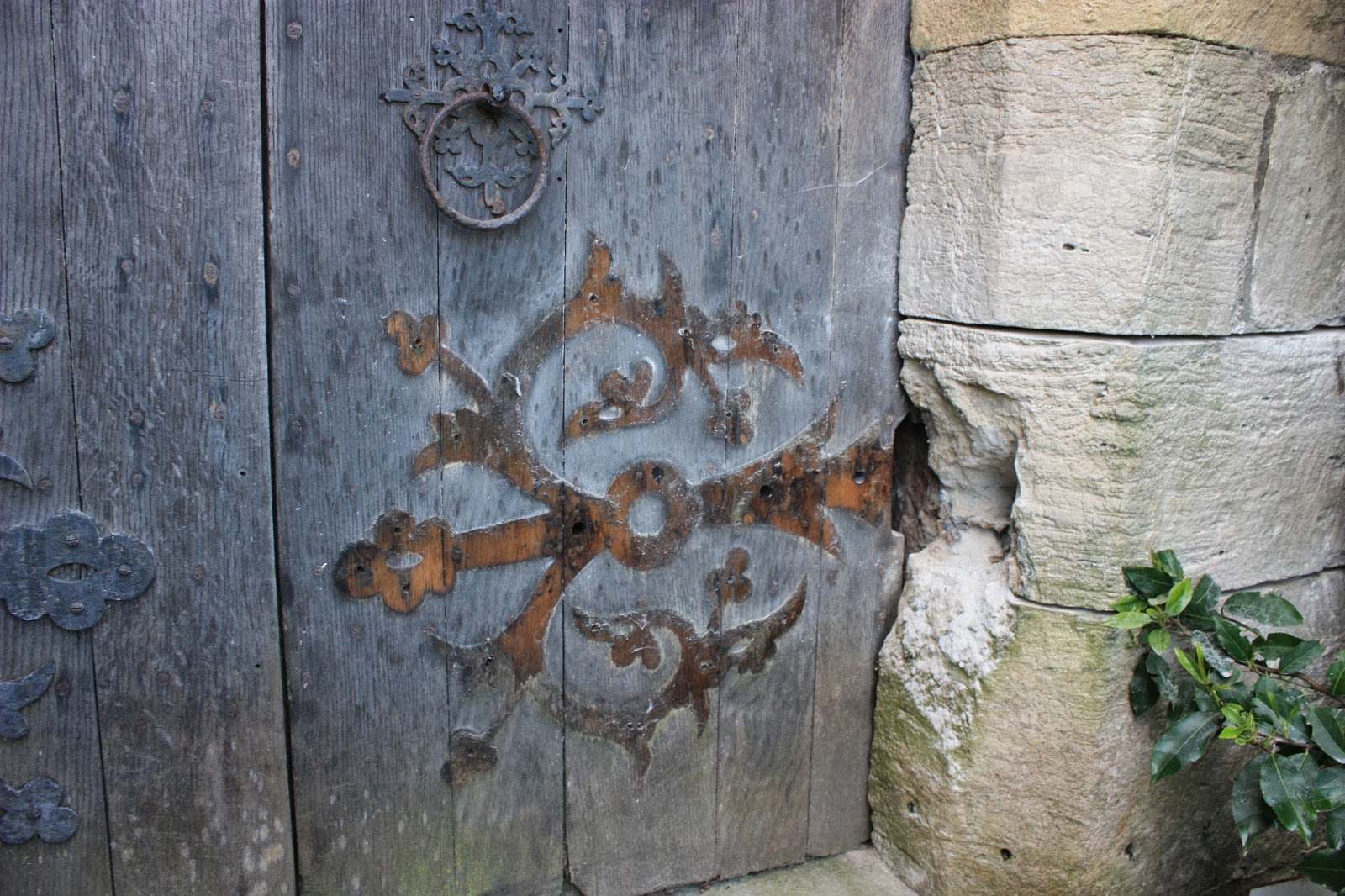
Known as The Dogs' Entrance (or Dog's Entrance depending on how many are in residence at the time) the wooden double doors leading out on to the moat are without doubt one of the Hall's gems.

Over an inch thick, with ornate hinges and enough security built in to the back to stop a small army (don't even think about it okay...?) the doors have featured in many a wedding photograph.

Because they face north they "get a lot of weather" - and boy have we "had a lot of weather" recently! And so it transpired that the doors were stronger than the house itself...

Now for the science part...

It is believed that the doors were hung there as part of the 1850s restoration, undertaken by JR Walbran on behalf of 3rd Lord Grantley. At this time numerous features were moved around - in part to protect some things from the elements*. It is not clear whether the doors were a part of the house's fabric before this - but that is where they ended up.

Hung on metal "pintles" inserted in to the stone archway that surrounds it, over time the pintles rusted and finally last year a large section of stone facing was forced away from the wall exposing the hinges and meaning that the bottom stone of the doorway needed to be replaced. 

And so the Stone Mason was called. He measured up and went away. The Black Smith was called. He measured up and went away. Finally, the stone was ready and new bronze (none-rusting) pintles had been forged...

Then we discovered that we couldn't get the door off!

The pintles are essentially large hooks - the door needs to be lifted off them - but at every attempt to lift the door it hit the arched entrance above it. 

After a lot of head-scratching, several cups of tea and a fair amount of hysterical laughter... it was decided to leave them where they are. Just for a while.

Answers on a postcard to...!

Wednesday, 18 December 2013

Further Festive Forays...


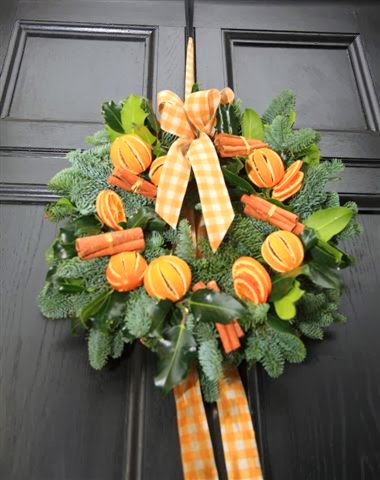
Next on our Christmas list was our very first (and hopefully the first of many) Luxury Door Wreath Workshop.

Hosted by the delightfully brilliant Joanna McCrea from Ripon's Twisted Willow floristry, five willing - and as it turns out, highly talented - participants arrived for coffee and mince pies at 10:00am.

By 1:00pm there were five perfectly crafted door wreaths on display!

The greenery came from the Estate and the lovely bits and pieces were supplied by Joanna with "extras" - including battery powered fairy lights - were also available.

Lunch was served in the Great Hall and the day was rounded off with a tour of the Hall by one of our knowledgeable guides.

Flowers By... is a series of workshops that we are very much looking forward to expanding on in the new year.

Tuesday, 17 December 2013

All things Festive & Lovely!

Markenfield has always been a little "out of bounds" in winter, due to the copious amounts of mud that begin to form towards the end of October and then increase in size and volume until it's wellies-all-round by December! 

This year however all is calm, all is bright (and shiny!) with the arrival of the new car park. It's very nearly there, and the mud is certainly diminishing daily!

And so to celebrate, we decided that this was the year Markenfield was going to join in with Christmas (think "John Lewis advert"!).

Firstly we decided to resurrect A Tour & A Tea - the success story of summer. Exactly what it says - a tour of the Hall followed by an afternoon tea.

The idea began in summer when we suddenly realised that each Friday in August was curiously free. The Mop-Up Mondays had been a great success and so we decided to do a Mop-Up... with scones!

We were amazed!!!! Each Friday in August we had a happy band of incredibly interested people who came and listened to a talk on the Hall and then sat out in the Orchard and enjoyed a beautiful Afternoon Tea Moat-side. It was so popular that on one afternoon we had over 30 people and were having to turn down bookings! 

So... "A Tour & A Tea - the Right House for Christmas" was born.

The idea actually came about back in August when one of our Guides was talking about the various houses owned by the Grantley family over the year and this passage from THE SILVER SPOON: Memoirs of the 6th Lord Grantley, sprung to mind:


“… Perhaps my father’s most outstanding characteristic, was his capacity for absent-minded lapses of memory. My memories of school holidays are somewhat jumbled, owing to the fact that my father developed a habit of taking a new country house every year.
The only place he never parted with was Markenfield Hall.
My Aunt Carlotta, who only visited us at Christmas or family occasions, was always much puzzled and once violently embarrassed, by my father’s peripatetic land ownership. The unfortunate old lady went to the wrong country house to stay with us one Christmas: no one, least of all my father having remembered to tell her that he had changed his abode."

Hence - the right house for Christmas! The story does continue...

“My Father… inherited five houses when my Grandfather died, of which Grantley was the largest. On one occasion, going up there by train, he was looking out of the window when he saw an uncommonly attractive house standing on a little hillside. He was so taken by it that he got out at the next station, and went to the largest Estate Agent in the town. He described the house in detail and said “I want to buy it”.

“But” protested the Agent “we have no house of that description on our books. Why should you think the owners wants to sell?”

“Find out the name of the house, the owner, and what he wants for it. And be quick about it”. Without another word, and without even bothering to say who he was, my father sat down and waited till the information was available.So great was his power of command that the whole office immediately went in to action. After a while the agent came up deferentially: “We are making some progress Sir, he said. “The house is called Elton Manor*. The owner is a  Lord Grantley…” 

*Elton Manor was subsequently sold and later demolished in 1933.

And it would seem that the love of Afternoon Tea has struck again - we are once again having to turn down bookings as this coming Friday's Tour & Toast as one Guide calls it, is now fully booked. Turkey sandwiches, Stollen, fruit cake & cheese (among other lovely nibbly bits) what's not to love?!


Tuesday, 3 December 2013

Fa la la la la!

 On the first Monday in December each year, Markenfield hosts what Celebrant Canon Punshon once described as "the start of Christmas" - a Service of Lessons and Carols, held in the Great Hall in aid of a Charity.

This year's Charity was the fabulous Hope & Homes for Children - a charity set up specifically to remove children from institutionalised settings and either return them to their families, or find a family that will provide them with the warm and loving home that their parents' could not.


Further information about the work of Hope & Homes for Children can be found here: 
http://www.hopeandhomes.co.uk/

The Charity works hard in the run up to the event to organise mulled wine, mince pies and the all important job of Decking the Great Hall with Boughs of Holly... (fa la la la la...).

Valerie and the Hope & Homes team did the Hall proud - the greenery, much of it collected from the Estate looked wonderful, and as ever the Hall came in to its own after dark - lit by the light of the altar candles and the scent of mince pies wafting up from below - it truly did feel like the start of Christmas.

A big thank you needs to go to Pam Dyson of Cascade Garden Centre, who allowed the Congregation to park in her car park. They were then brought to the Hall by the ever-cheerful drivers of Aquarius Mini-Coaches of nearby Kirky Malzeard. The works to the car park meant that parking the 80-strong guests would have been nigh on impossible. Several sing-alongs were reported and as a real treat the coaches dropped their passengers at the door! 


It was however noted that - despite the efforts of Hope & Homes to arrange alternative parking, pay for the coach transfers and send out all instructions at the beginning of November - what is currently left of the car park was full! 

That, and the fact that 22 people were still being awaited at the Garden Centre once the Service had started meant that some of our Congregation had not read their paperwork...

You know who you are!


Next year's Service will be organised by, and held in aid of, 
Bishop Thornton School.
Tickets go on sale at the beginning of November - watch this space!


Thursday, 17 October 2013

Operation Car Park: Week One

The Car Park at Markenfield has never been quite the same since it was dug up twice in quick succession - once by BT looking for a junction box, and once by the water people looking for a leak!

The surface became lumpy and began to hold water. The grass disappeared and the whole area began to resemble the surrounding farm land rather than somewhere for visitors to park their once-clean cars.

A brand new car park has been on the cards for many years now - but how to fund it? What to do with it to keep it in keeping? A concrete monstrosity just wouldn't do. Tarmac? Sacrilege! 

As it turned out, inspiration wasn't too far away!

It was decided that the new Car Park should be surfaced in a pale hardcore to match the central aisle of the Courtyard and then edged in cobbles. 

The cobbles in the Courtyard were unearthed when the grass was edged one day by the Hall's gardener and the decision was taken to preserve and maintain them rather than to grass over them again.

They are a handsome feature of the Courtyard and actually run along the side of the Gatehouse too. So it was only natural that the thought of introducing them in to the Car Park too was greeted with enthusiasm by English Heritage.

Because the Car Park is on land Scheduled as an Ancient Monument, English Heritage have been involved from the very beginning. Most car parks do not require Consent from the Secretary of State and an Archaeologist on stand by!

So, work began this week on scraping off what remained of the old grass surface. What was underneath was then leveled by hand proving a hard standing surface for the Hall's staff still to park on.

Luckily the existing drainage from the farm buildings still worked... we knew that following a morning of frothy pouring water down various holes and then running round to see if the moat was frothy too... a bit like Pooh Sticks - but with bubbles! So the surrounds to the run off drains will be made this week by the Hall's Stone Mason and then it's cobble time...


Funnily enough... it would appear that someone (several hundred years ago) had the same idea! Look what was uncovered against the farm buildings - just under the grass.

Wednesday, 17 July 2013

The Bats & The Bees...

Wildlife seems to be high on the agenda at the Hall this week, with a wide variety of creatures - great and small - making their presence known.


This little fellow made an appearance in The Gatehouse last week - he was incredibly tiny and tangled in the cobwebs on the wall by the window. A quick check on The Bat Conservation Trust website confirmed that he really shouldn't be there and he was popped in a box awaiting collection by one of their Volunteers.

At 9:00pm that night, a slightly odd assortment of people gathered around a cardboard box to see what it was that we had... a baby bat - less than a week old.

It was imperative that he was reunited with his mother and we spent over an hour scouring The Gatehouse for possible bat entrances, but unfortunately none could be found. It was decided that perhaps mother had been carrying him whilst searching for food and either abandoned him - or he had simply fallen off.

Back out in the Courtyard Nick (otherwise known as The Bat Man) set up his bat detector and we spent a further hour watching in awe as bats swooped and soared around us. He identified at least three species, including the solitary Long Eared Brown Bat. Nick is planning to return in order to identify the possible roosting sites within the Courtyard.

Another new arrival at the Hall - Hadrian's Bees. If you read the Blog on a regular basis you will already have come across Hadrian, the Hall's Dry Stone Waller. Not only is he a superbly talented waller, he is also a keen Apiarist. 

He has installed two hives of bees to the west of the Hall, positioned so that they will (hopefully) take full advantage of Spring Wood and the abundance of wildflowers that flourish there.

Monday, 17 June 2013

Lumps, Bumps, Bodies and... Bunnies!


South of the Hall, and sitting along-side the main drive, is a peculiarity of the Hall - known affectionately as The Lumps and Bumps Field. It is Scheduled as an Ancient Monument, along with the land that the Hall sits upon and all the land within the Park Pale.

The area is described as follows in the Scheduling document originally drawn up in 1977:

To the south of the current farm buildings, which lie to the immediate south of the moat, are the substantial earthwork remains of the service buildings for the medieval complex. These buildings lay within an outer court and include well defined remains of at least four buildings laying either side of a later field wall. The remains survive up to 0.5m high and include a building platform 10m by 5m surrounded by a shallow gulley some 1.5m wide. To the east of these remains are two substantial earthen banks 5m apart and up to 0.5m high which extend east for 70m then turn to extend south for 100m, and which are interpreted as the sides of a track way. The curtain wall which surrounded the outer court survives as a prominent bank along the western side of a track extending south west from the farm buildings. To the west of this wall, outside the outer court, are remains of ridge and furrow cultivation. The southern and eastern sides of the outer court are defined by the park pale but the location of the boundary on the north side is currently unknown.

Various people, at various times over the years have hazarded various guesses about the origins of these Lumps and Bumps. The general consensus - and the version told during guided tours of the Hall - is that they are the remains of the original mediaeval village that would have sprung up to support the Hall and its associated activities - such as labourers, craftsmen, farmers and the like. This possibility is also hinted at in the English Heritage Scheduling:

A park pale was the boundary around an area of land often set aside and equiped for the management and hunting of deer and other animals although farming also took place. They were generally located around or adjacent to a manor house, castle or palace. Parks could contain a number of features, including hunting lodges, a park keepers house, rabbit warrens, and enclosures for game. They were usually surrounded by a park pale, a fenced, hedged or walled boundary often on a massive bank with an internal ditch. The peak period for the laying out of parks, between AD 1200 and 1350, coincided with a time of considerable prosperity amongst the nobility. Parks were established in virtually every county in England and were a long lived and widespread monument type. Today they serve to illustrate an important aspect of the activities of medieval nobility and still exert a powerful influence on the pattern of the modern landscape. Where a park pale survives well, and is well documented or associated with other significant remains they are normally identified as nationally important. The medieval fortified house complex at Markenfield Hall survives well. The full extent of the outer court is known and earthwork remains of its enclosing wall and buildings are preserved. The associated park pale also survives well and is unusually complete. Taken together the remains demonstrate a rare survival, offering important scope for understanding the nature and functions of a medieval complex and its impact on the wider economy and landscape.

This belief was changed briefly back in 2011 when Historical Dowsers worked their way across the Courtyard, the Car Park, the One Acre Paddock and the Lumps and Bumps Field to try and identify what historical archaeological secrets could be hidden under the surface. They identified the outlines of numerous buildings within the Courtyard, and it was truly fascinating to see the outlines of buildings from days gone by begin to take shape in front of your eyes.

When the Dowsers got to the Lumps and Bumps Field however they did not find the anticipated mediaeval village - instead they identified three plague burial pits. Not exactly the "View from the Gatehouse" that a girl wants each day!!!

Then, not a year later, we were privileged to welcome historical writer Richard Almond to the Hall. He was speaking for The Friends on the subject of the Park Pale and mediaeval hunting in general. He identified the Lumps and Bumps as rabbit warrens. 

His explanation being that when rabbits were first imported to this country, they were above-ground animals used to a hot climate and that in order to survive they had to be "taught" to live underground away from snow, wind and rain. Thus it was that artificial rabbit warrens were built consisting of stone tunnels and chambers; and this is what we have here at the Hall.

I was lucky enough to meet The Muddy Archaeologist (otherwise known as Gillian Hovell) at the Ripon Local and Familiy History Fair last week and plans are under way for her to come and look at our Lumps and Bumps with a view, not only to providing a definitive answer, but to put on a lecture (or two..) about the Hall and its archaeology based on her extensive knowledge of landscape archaeology. Muddy Markenfield... it has a ring to it!